PELOTON INTERACTIVE (PTON)·Q2 2026 Earnings Summary
Peloton Q2 FY2026: CFO Exit Overshadows EBITDA Beat as Stock Drops 8%
February 5, 2026 · by Fintool AI Agent
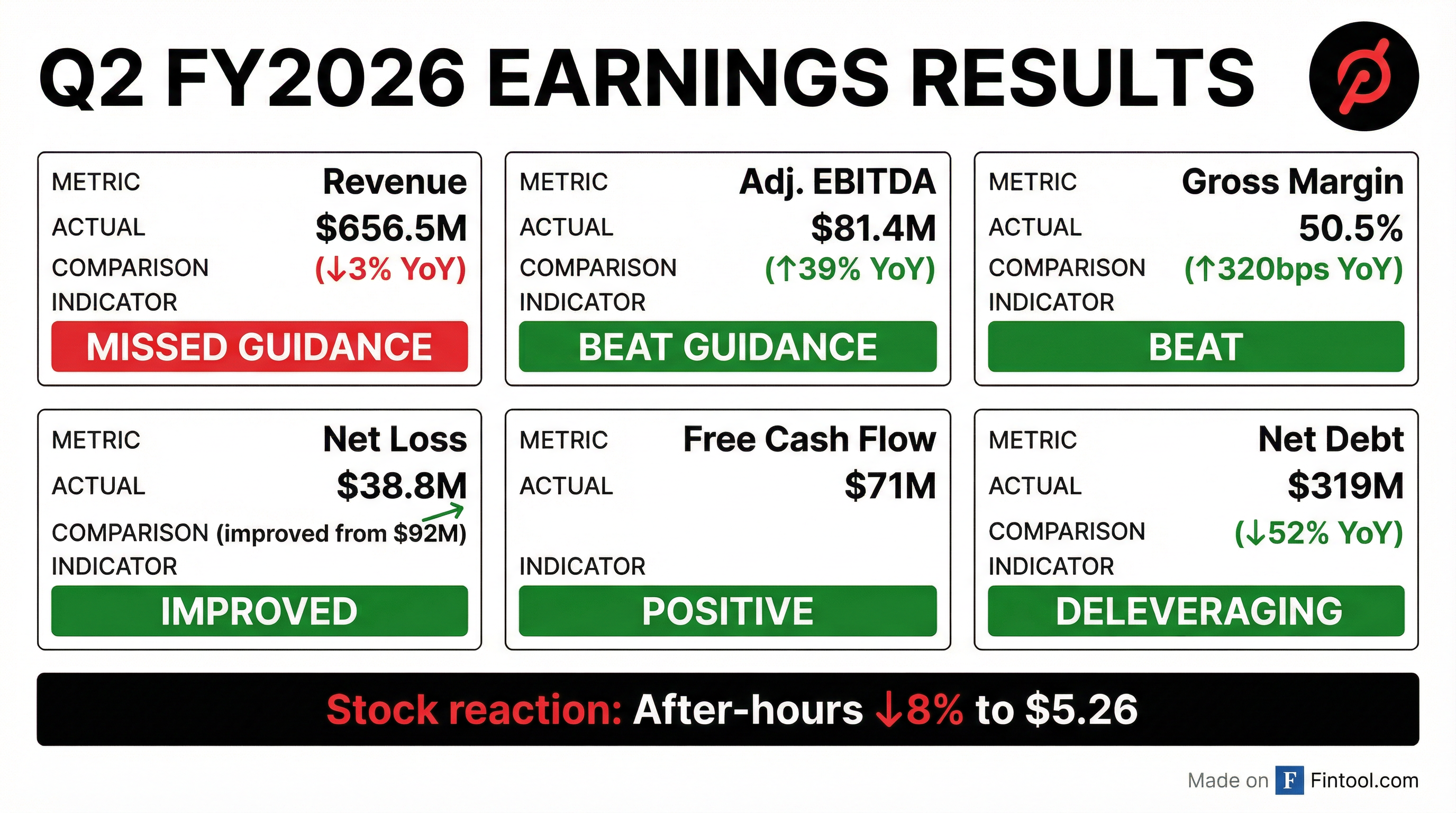
Peloton delivered mixed Q2 FY2026 results that highlighted the ongoing tension between revenue pressure and profitability improvement. Revenue of $656.5M missed the company's own guidance range by $8M, while Adjusted EBITDA of $81.4M beat the high end by $6M. The bigger story, however, is the unexpected departure of CFO Liz Coddington, who architected much of the company's financial turnaround over the past four years.
The market's initial reaction was decisively negative—shares dropped ~8% after hours to $5.26, suggesting investors are more concerned about leadership continuity and top-line weakness than the profitability beat.
Did Peloton Beat Earnings?
The short answer: Beat on profitability, missed on revenue.
The revenue miss was driven by "lower-than-expected Connected Fitness Product sales to existing Members." Hardware refresh cycles continue to underwhelm as existing subscribers prove reluctant to upgrade equipment despite the new Cross Training Series launch.
Year-over-year trends tell a more positive story:
*Values retrieved from S&P Global for historical periods where citations unavailable.
 Ask Fintool AI Agent
What Happened With the CFO?
CFO Liz Coddington announced her departure to pursue an opportunity outside the fitness industry, effective March 27, 2026. This was a surprise—Coddington was widely credited with stabilizing Peloton's finances during its post-pandemic restructuring.
Key details:
- Departure is not related to financial disclosures or accounting matters
- She will not receive severance under the company's existing plan
- Comprehensive CFO search has been initiated
CEO Peter Stern's statement emphasized Coddington's contributions: "She leaves us not only with a better balance sheet, but also a renewed sense of financial discipline."
Why this matters: CFO transitions at turnaround companies create uncertainty. Coddington navigated debt refinancing, cost restructuring, and the shift to profitability. Her replacement will need to maintain credibility with bondholders while the company still carries $1.5B in debt.
What Did Management Guide?
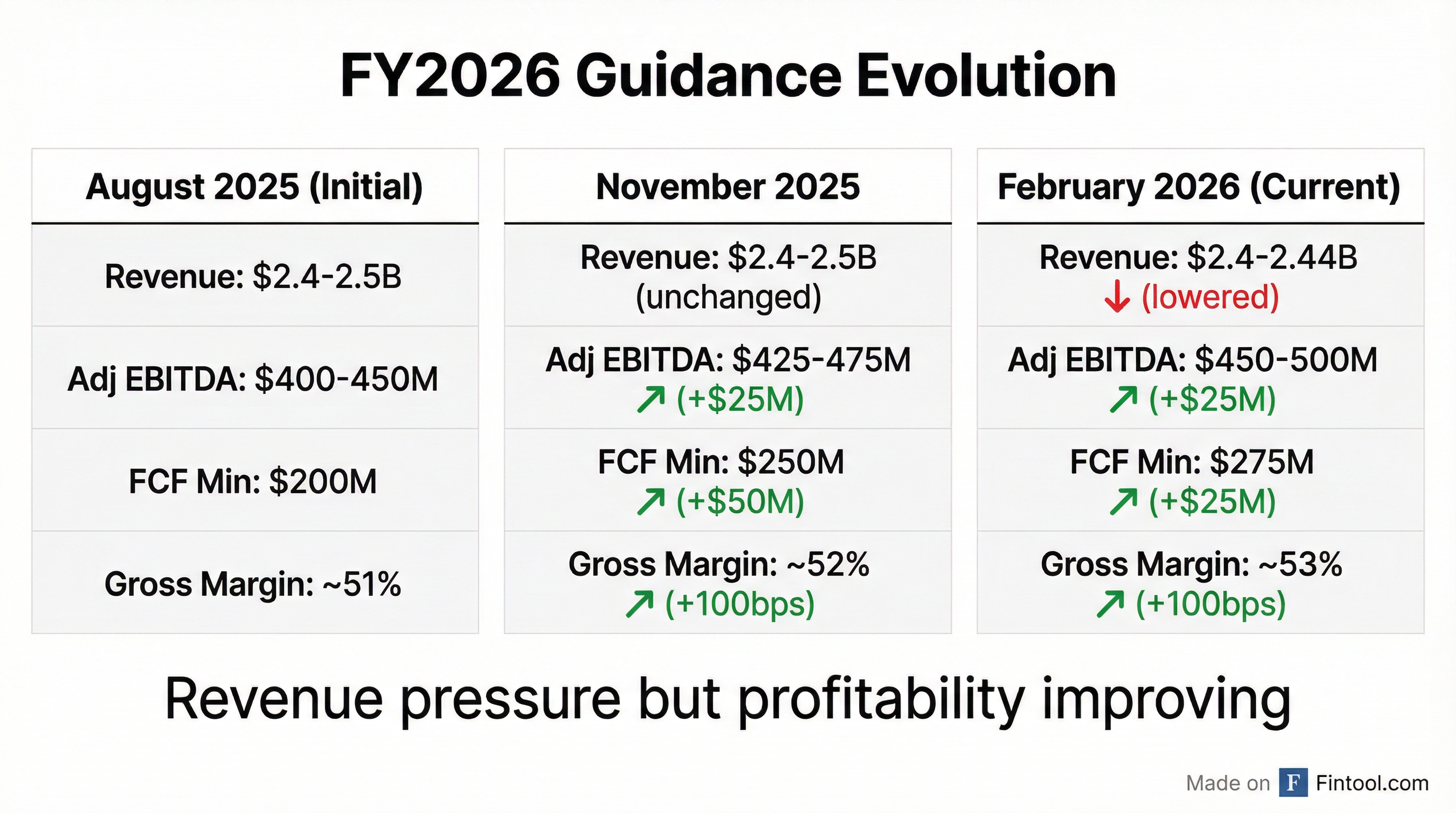
Peloton's guidance tells a familiar story: revenue under pressure, but profitability accelerating.
Q3 FY2026 Outlook
Full Year FY2026 Outlook Changes
The guidance progression shows a company prioritizing profitability over growth—three consecutive quarters of EBITDA guide raises while revenue expectations compress.
Ask Fintool AI AgentHow Did the Stock React?
After-hours reaction: Down ~8% to $5.26 from the $5.72 close.
This marks a significant reversal from the pre-earnings run-up where PTON gained 3% on the day. The CFO departure news, combined with the revenue miss, outweighed the positive EBITDA and guidance developments.
Context matters: PTON is trading well below its 50-day moving average ($6.32) and 200-day average ($6.99). The stock has lost over 48% from its 52-week high of $10.25.
What Changed From Last Quarter?
The Good:
- Subscription churn better than feared following October 1 price increases—churn of 1.9% was lower than expected despite the price hike
- Net debt continues declining—$319M vs. $670M a year ago, down 52%; net leverage at 0.8x vs 2.9x a year ago
- Commercial business growing—10% revenue growth YoY in the Commercial Business Unit, exceeding expectations across U.S. and international markets
- AI engagement encouraging—46% of active members engaged with Peloton IQ; personalized plan engagement up >10% QoQ
- MicroStores outperforming—driving 8x sales per sq ft vs legacy showrooms
- Club Peloton loyalty exceeded targets—24% member engagement vs 20% target
The Concerning:
- Hardware sales to existing members disappointing—the upgrade cycle isn't materializing. CEO Stern attributed this to the "quality and durability of the existing equipment" and high member satisfaction, noting their only prior data point was Bike+ (a full frame redesign)
- Subscriptions still declining—2.661M down 7% YoY
- Free cash flow timing—Q2 FCF of $71M included ~$25M of timing benefits
- Third-party retail underperformance—sales lagged expectations; management is "working with distribution partners to share best practices"
- Leadership uncertainty—CFO departure adds execution risk
Key Management Quotes
"Our second quarter represented the most substantial period of innovation at Peloton since our founding. At the same time, our financial performance demonstrated our continued operational discipline, resulting in 39% year-over-year growth in Adjusted EBITDA and reducing Net Debt by 52% year-over-year." — Peter Stern, CEO
"I will not be satisfied until this company is back to healthy, sustained, top-line growth." — Peter Stern, CEO, Q&A
"It has truly been a privilege to serve as CFO of Peloton. I am incredibly proud of the work we have done together to dramatically improve our financial profile... I will do so with mixed emotions, knowing that Peloton's best days lie ahead." — Liz Coddington, outgoing CFO
The CEO's acknowledgment that revenue growth remains the key missing piece—while being transparent about his own dissatisfaction with current performance—sets a clear marker for future accountability.
Segment Breakdown
Connected Fitness Products (Hardware)
Hardware remains under pressure, though margins are expanding as product mix shifts toward higher-margin units and cost improvements take hold.
Subscription
Important margin nuance: Subscription gross margin benefited from a $9.7M nonrecurring reduction to accrued music royalties. Excluding this benefit, subscription gross margin would have been 69.7%—still +180bps YoY improvement, of which 100bps was driven by subscription pricing changes net of churn.
Balance Sheet & Cash Flow
Peloton's deleveraging story remains compelling:
Free Cash Flow of $71M in Q2 and $275M minimum target for FY26 provides runway to continue debt reduction.
Near-term capital actions:
- $200M convertible notes due this month (0% coupon) will be paid down
- $1B term loan has 1% prepayment penalty through May 2026—management is "mindful of this timing"
- Refinancing expected to "deliver a lower cost of capital and more flexibility over time"
Q&A Highlights
On the path back to growth: CEO Stern outlined five pillars: (1) more complete product offerings with right price points, (2) appropriate subscription pricing (done in Q2), (3) improving net churn, (4) exploiting new growth avenues like CBU (10% YoY growth), and (5) demonstrating efficient operations.
On existing member upgrade patterns: The only historical data point was Bike+, which was "a really fundamental reinvention of the entire frame." The Cross Training Series refresh didn't drive the same upgrade velocity. Management believes this reflects equipment durability and high satisfaction rather than weak demand for new products.
On commercial business strategy: The CBU is now viewed as "a new vector for profitable growth" on a standalone basis—not just a subscriber acquisition channel. Precor relationships span 60 countries and tens of thousands of gym operators. The recently relaunched Precor slatted belt treadmill saw pre-orders exceed expectations.
On hardware roadmap: Stern declined to announce new products but expressed confidence in "meaningful announcements in the next 12-18 months" and praised the hardware team's ability to "produce really high-quality equipment in a very short period of time."
On guidance assumptions: CFO Coddington clarified that guidance does not assume any of the Q2 softness from existing member sales is timing-related. The lower sales to existing members are built into the updated guidance, not deferred.
Retail & Distribution
MicroStores outperforming: Peloton scaled to 10 MicroStores by end of October. These capital-efficient, Peloton-managed showrooms are driving more than 8x sales per sq ft versus legacy showrooms.
Member Engagement & Initiatives
Club Peloton Loyalty Program: Launched October 1, the new loyalty program exceeded expectations with 24% of active members engaged (vs. 20% internal target). Members using exclusive apparel discounts drove nearly 50% of Q2 apparel purchases.
Peloton IQ adoption:
- 46% of active members engaged with performance insights/recommendations in first quarter since rollout
- Personalized plan engagement up >10% from Q1
- Ranked #1 vs. Apple and Google AI fitness coaching by The Wall Street Journal
- Ranked most compelling feature by Cross Training Series Bike+, Tread, and Tread+ buyers
Content engagement:
- Workout time per connected fitness subscription up 7% YoY
- Turkey Burn 2025: 6% increase in completed live workouts YoY; The Feast strength class saw 24% increase—biggest live strength class ever
Health partnerships:
- Twin Health: Personalized guidance with Peloton content to improve metabolic health and reverse type 2 diabetes. Several thousand Twin Health members now engaging.
- Respin Health menopause study: 60-day program with 200+ members showed 84% experienced overall symptom improvement (brain fog, energy, weight, memory).
Forward Catalysts
Potential Positives:
- Cross Training Series uptake in Q3/Q4 as awareness builds
- Commercial Business Unit growth with Peloton Pro Series and Precor expansion
- Peloton IQ driving better retention/engagement
- Capital structure refinancing expected to lower cost of capital
- Hardware roadmap announcements in next 12-18 months
- New CFO with fresh perspective
Potential Risks:
- CFO transition creates execution risk during critical period
- Revenue decline accelerating if hardware refresh fails
- Subscription churn could worsen post-price increase
- Tariff exposure (~$45M FCF impact embedded in guidance); "remains a dynamic situation that may change"
Ask Fintool AI AgentKey Takeaway
Peloton's Q2 FY2026 results encapsulate the company's current reality: profitability is improving, but growth remains elusive. The 39% YoY EBITDA growth and continued deleveraging are genuine accomplishments. But the revenue miss and CFO departure create near-term uncertainty that the market is pricing in.
The bull case rests on the new product cycle (Cross Training Series), AI engagement (Peloton IQ), and Commercial expansion eventually translating to subscriber stabilization. The bear case points to persistent hardware weakness, accelerating sub losses, and now leadership transition risk.
For investors, the key question is whether the profitability improvements are sustainable enough to offset—or eventually reverse—the top-line pressure. Q3 guidance for 43% EBITDA growth suggests management believes they can maintain margin momentum even as revenue contracts.
Related Links: